Lena's Biology
Unit 1 · Plants and animals. Sections 1–5: Organisms, Growth and development, Metamorphosis, Humans, Making food. Section 6 follows when the pages arrive.
Your exam
How to use this
One section a day: read the Know this card, then do every game in that section until you get 100%. Finish with Cards (5 minutes) and, from the day before the exam, Exam mode until you score 18 or more out of 20.
How to get a top score
- Use the book's words. "Excreting", not "peeing". "Imago", not "grown-up butterfly". The test rewards the exact terms.
- Explain questions want a reason. Always write "because…". Example: "A wooden plank is dead because it was once part of a living tree; its life processes have stopped."
- Growth = bigger and heavier. Development = new parts or a new shape. If something appears (teeth, fur, roots, flowers, legs), it is development.
- Dead vs non-living: ask "was it ever alive?" Yes → dead. Never → non-living.
- Lifecycles: be able to write the stages in order from memory: tomato (9 steps), cabbage white (4 stages), frog (8 steps).
Basics 1 · Organisms
Know this
Biology = the study of life (Greek bios = life, logos = study). An organism is a living creature: humans, animals, plants, bacteria and fungi are all organisms. A stone is not.
All organisms have life processes. The life processes tell you whether something is living. There are seven:
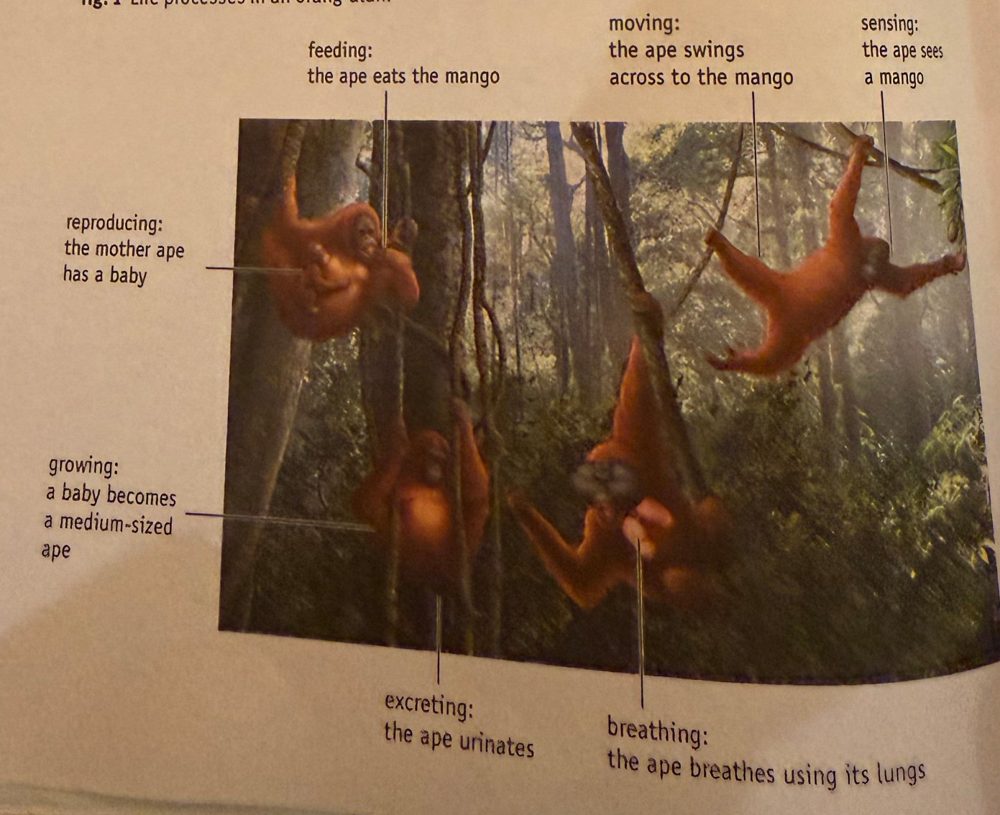
| Group | Life processes | What it means |
|---|---|---|
| Uptake and elimination of substances | breathing, feeding, excreting | Breathing takes in oxygen. Feeding = eating and drinking. Excreting = releasing waste substances into the surroundings (exhaling, urinating, sweating). |
| Reacting to the environment | sensing, moving | A rabbit sees and hears a threat (sensing) and hops back to its burrow (moving). |
| Survival of the species | reproducing, growing | Offspring make sure a group of organisms keeps existing. The young grow, then reproduce themselves. |
Living, dead, non-living
- Living: the life processes are happening (heron, dragonfly, grass, farmer).
- Dead: it was alive, but the life processes have stopped (fallen tree, skull, dead fish, mown grass, a wooden plank).
- Non-living: it was never alive (rocks, air, water, a tractor, a cola can, an iron gate).
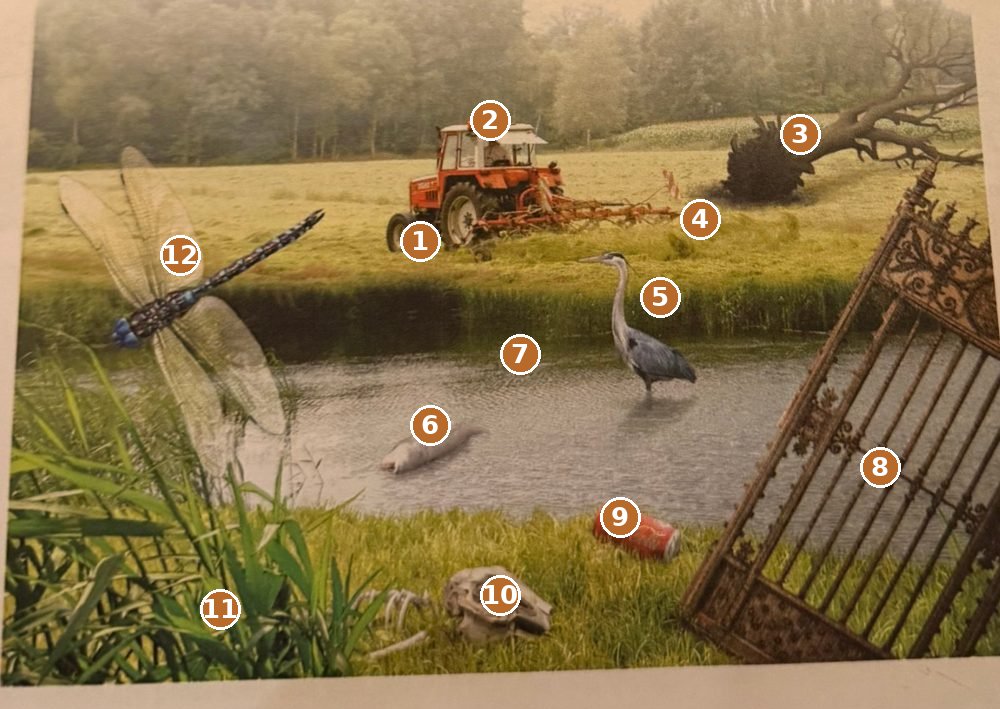
Non-living things still matter for living things: water, air and sunlight have a huge influence on living nature.
Life process groups
Which of the three groups does each life process belong to? 14 questions.
Which life process?
Read the situation, pick the life process. Some have two answers: tap both, then Check. 15 questions.
Living, dead or non-living?
The question to ask yourself: was it ever alive? 16 items, some from the picture in Know this.
Explain it
These are the kind of open questions that come up on the test. Say the answer out loud, then tap the card to compare with the model answer.
Basics 2 · Growth and development
Know this
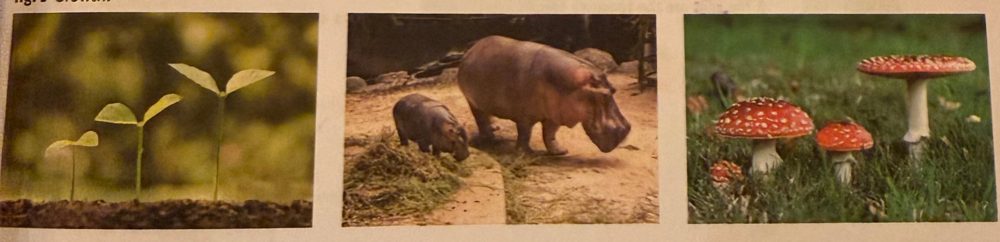
Growth = an organism gets larger and heavier. Development = changes in the structure (shape) of an organism: new parts appear, such as stems, leaves, teeth, fur. Development lets the parts work better (roots that branch off absorb water better).
A seed (brown bean)
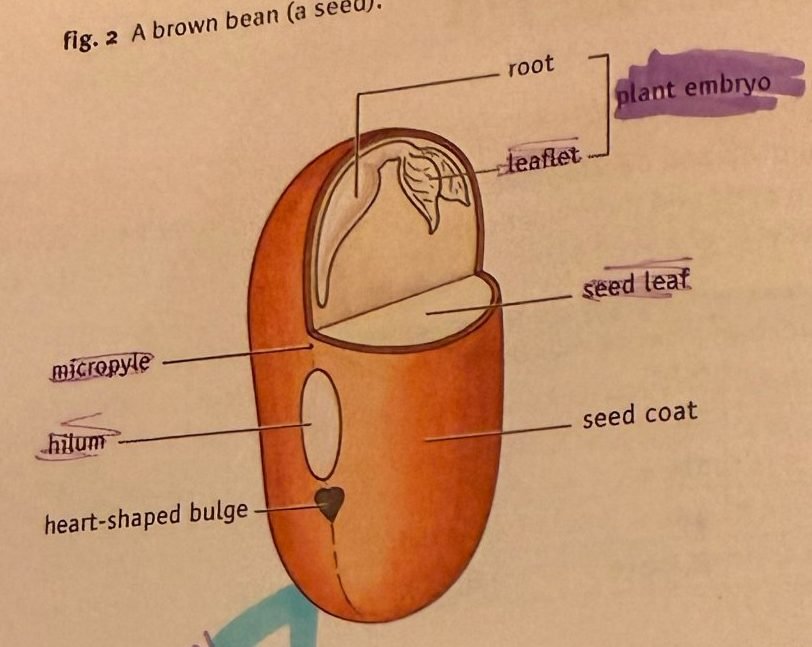
| # | Part | Function |
|---|---|---|
| 1 | seed coat | tough brown skin; protects the seed |
| 2 | seed leaves | the two halves of the seed; store nutrients (reserve food); become the first leaves above the ground; wither away once the nutrients are used up |
| 3 | hilum | white spot; where the seed was attached to the parent plant |
| 4 | heart-shaped bulge | dark heart shape just under the hilum |
| 5 | micropyle | very small hole in the seed coat on the other side of the hilum; the seed absorbs water quickly through it |
| 6 | plant embryo | the start of a new plant: a root and a leaflet |
Germination starts when the seed absorbs water. The embryo grows into a seedling, using the nutrients from the seed leaves. Water is what a seed needs to start; without water a seed can stay in the soil for centuries (ancient seeds).
Lifecycle of a tomato plant (9 steps)
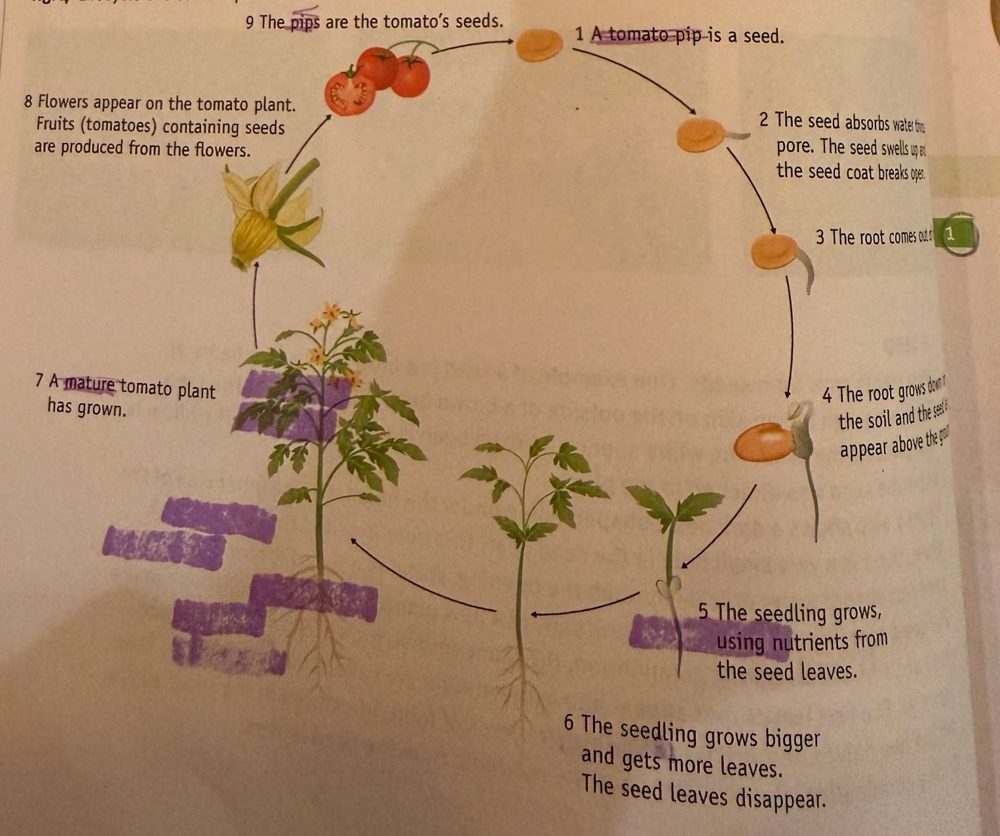
- A tomato pip is a seed.
- The seed absorbs water through the pore (micropyle). It swells up and the seed coat breaks open.
- The root comes out of the seed.
- The root grows down into the soil; the seed leaves appear above the ground.
- The seedling grows, using nutrients from the seed leaves.
- The seedling grows bigger and gets more leaves. The seed leaves disappear.
- A mature tomato plant has grown.
- Flowers appear; fruits (tomatoes) containing seeds are produced from the flowers.
- The pips are the tomato's seeds. The cycle starts again.
Three stages: germination (steps 2–3), seedling (4–6), mature plant (7–9). A lifecycle is a process that keeps repeating: the end of one cycle is the start of the next.
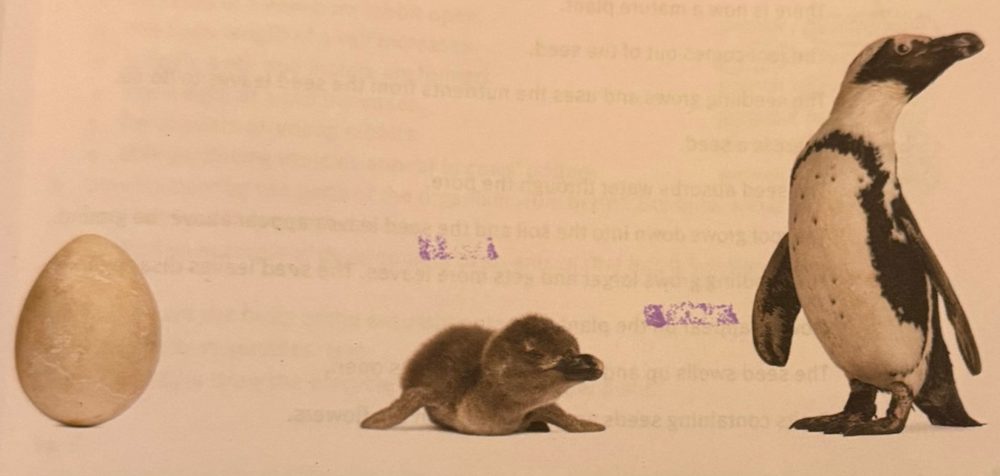
Animals grow and develop too: inside a penguin egg a lot of development happens; the chick already has the body structure of an adult, then mostly grows (bigger and heavier).
Growth or development?
Bigger/heavier = growth. New part or new shape = development. 18 statements.
Parts of a seed
Name the part from its description or its number in the diagram. 14 questions.
Tomato lifecycle
Tap the steps in the right order, starting with the seed. A wrong tap counts as a mistake; aim for zero.
Which stage?
Germination, seedling or mature plant? 10 questions.
Explain it
Open questions from the Insight exercises and the two texts (Ancient seeds, Plants are urbanising). Answer out loud, then tap to compare.
Basics 3 · Metamorphosis
Know this
In some animals the young look nothing like the adults. A larva comes out of the egg; it looks different from the adult and often eats different food. Before it becomes an adult it undergoes a transformation: metamorphosis. During metamorphosis the animal's body structure and its way of life change.
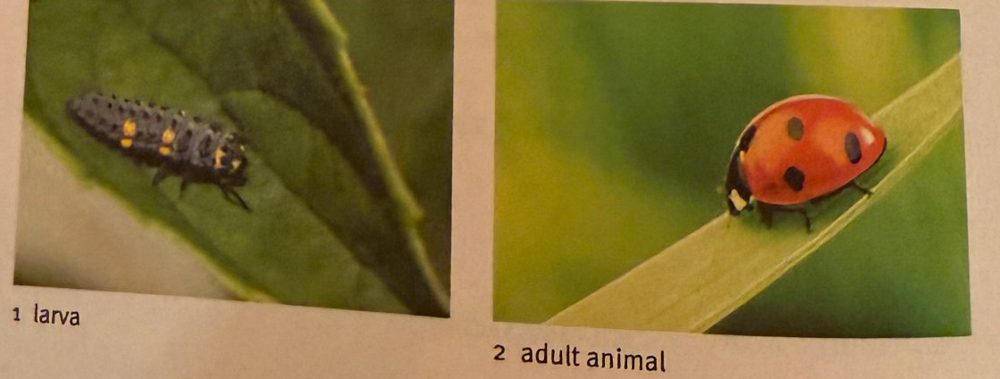
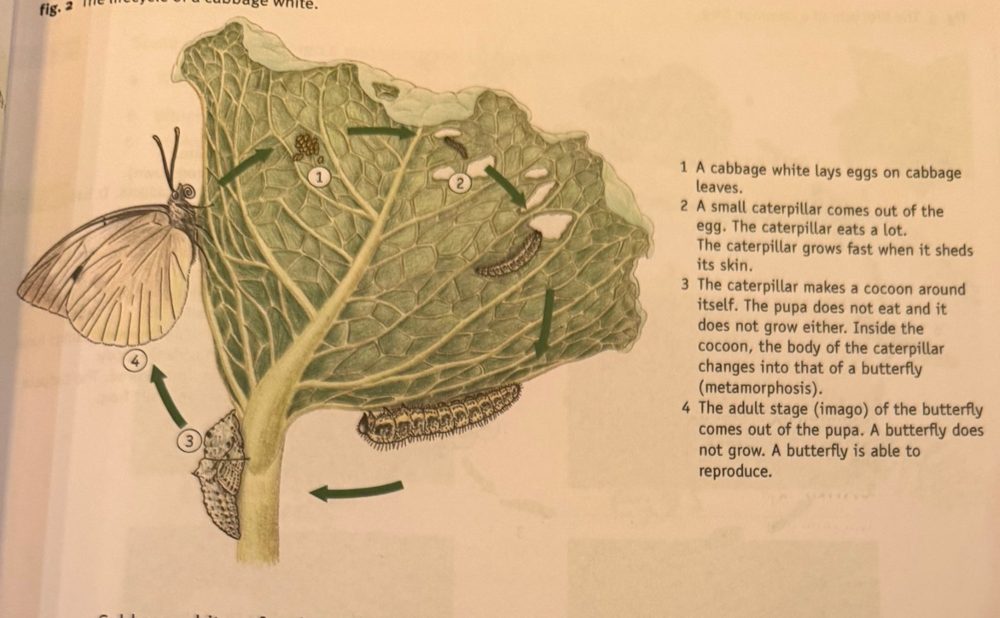
Cabbage white (butterfly): 4 stages
| Stage | What happens |
|---|---|
| egg | laid on cabbage leaves; after a few warm days a larva comes out |
| larva (caterpillar) | eats a lot and grows. Its tough armour cannot grow, so it sheds its skin several times; right after shedding, before the new armour hardens, it grows a lot. This is the stage with the most eating and the most growing. |
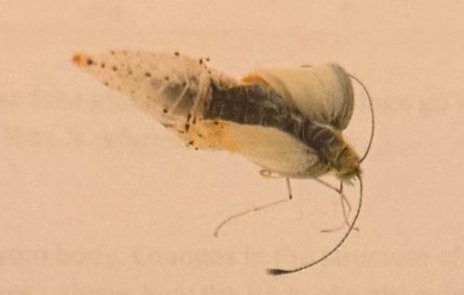
| pupa (chrysalis; the casing is the cocoon) | does not eat, does not move, does not grow. The metamorphosis happens inside: wings, large eyes, a proboscis (roll-up tongue) and antennae appear. After 2–3 weeks it breaks open. |
| imago (adult butterfly) | dries off for a few hours, then flies. A butterfly does not grow. It can reproduce. |
Beetles (ladybird), bees, flies and wasps have the same four stages.
Common frog: 8 steps
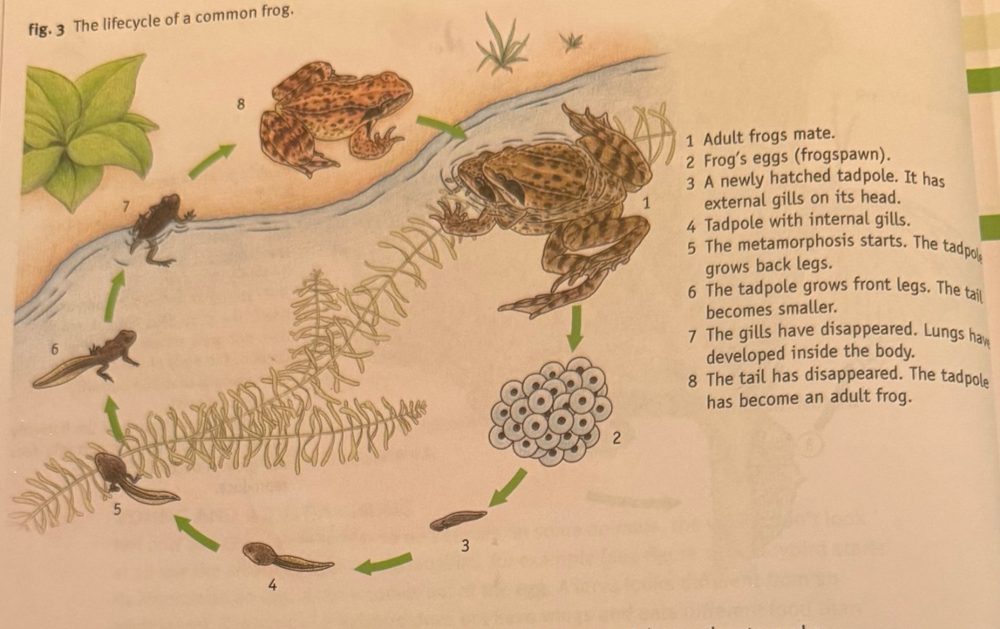
- Adult frogs mate.
- Frogspawn: eggs stuck together in a clump of up to 3000.
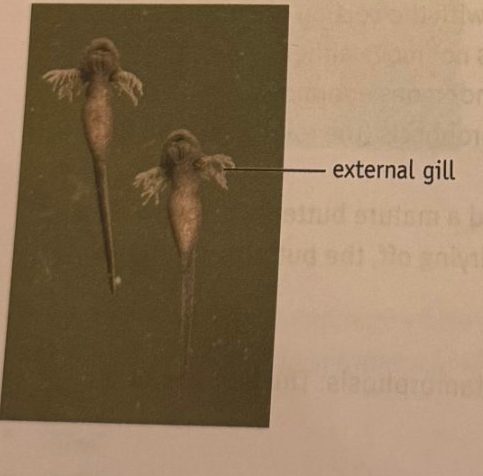
- A newly hatched tadpole (about 6 mm) with external gills on its head.
- Tadpole with internal gills.
- Metamorphosis starts: the tadpole grows back legs.
- Front legs grow (after 8–9 weeks); the tail becomes smaller.
- The gills have disappeared; lungs have developed inside the body.
- The tail has disappeared; it is an adult frog (about 15 mm after 12–13 weeks).
A tadpole eats mostly algae and gets oxygen from the water through its gills and skin. An adult frog eats insects and gets oxygen from the air through its lungs and skin. Lungs are why a frog can live on land.
Head lice: no real metamorphosis
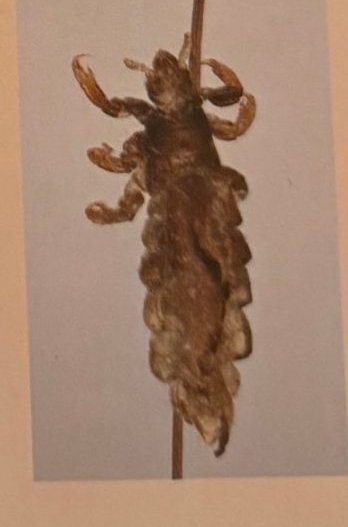
Egg = nit → after 6–7 days a nymph crawls out → adult (imago). A nymph is not a larva: it already looks like an adult louse. Nymphs do not pupate; they shed their skin about three times in ten days and grow after each shedding. Lice live off blood.
Butterfly stages
Egg, larva, pupa or imago? 16 questions.
Frog lifecycle
Tap the 8 steps in order, then do the same for the butterfly and the head louse.
Frog & louse facts
The numbers and details the test likes. 16 questions.
Explain it
The Insight questions: caterpillar growth graph, tadpole tail, "itching like nits", why a child is not a larva.
Basics 4 · Humans
Know this
As you grow and develop, your body changes. Things go especially quickly between ages 12 and 16: puberty.
Three types of development
| Type | What it is | Examples |
|---|---|---|
| physical development | changes in the structure of your body | breasts develop, beard growth, reproductive organs start to function, becoming pregnant |
| mental development | development of intelligence, emotion and personality | learning to read, moods and emotions changing, thinking about yourself and the world, becoming independent |
| motor development | learning certain movements | a toddler learning to walk or talk, building a tower, using your hands, riding a bicycle, walking with a wheeled walker |
Growth of a girl (fig. 1, redrawn)
Two growth spurts: in the first year (0–1) and in puberty (12–16, about two years). Between 12 and 16 the body shape also changes (physical development); after 16 a girl hardly grows any more.
Stages of life: eight phases
| Stage | Ages | What is typical |
|---|---|---|
| baby | 0–1 | dependent on other people; grows very fast: the first growth spurt |
| toddler | 1–3 | learns a great deal: talking, walking, building a tower (motor development) |
| pre-schooler (nursery school) | 3–5 | learns to play games, use a screen, ride a bicycle, draw, play with other children |
| schoolchild (junior school) | 6–12 | learns to read, write and do arithmetic |
| teenager (adolescent) | 12–16+ | puberty: second growth spurt (about two years, earlier in girls); reproductive organs start to function; breasts / beard; moods swing; first love |
| young adult | 16–21 | learns to be independent |
| adult | 21–65 | fully independent |
| elderly (senior citizen) | 65+ | often physical problems; many need help as they get older |
The stages do not last equally long in all people: some children develop quickly, others more slowly. The ages are average ages.
Average heights of boys and girls (fig. 3, redrawn)
Girls are taller than boys on average between about 8½ and 14, because their puberty growth spurt starts earlier. Boys start later but grow more, so eventually boys are taller.
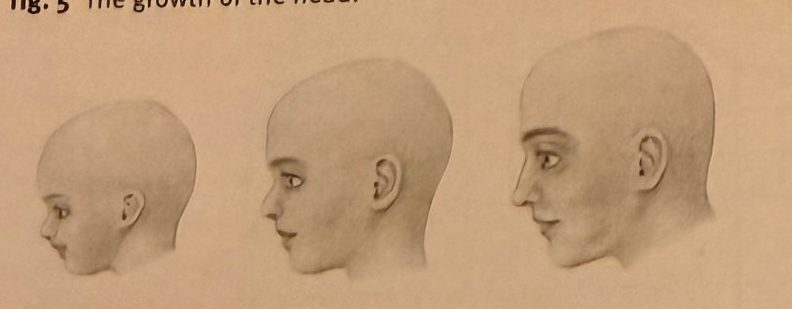
The head changes shape (fig. 5)
Internet and development
Positive for mental development: learning to network, taking part in discussions, making video clips, reading articles, sharing knowledge, improving languages. Negative for mental development: exposure to violence, online bullying, sexual abuse, misuse of personal data (webcam images), accepting ideas uncritically as the truth. Negative for motor development: no exercise during long periods online; also a higher risk of diabetes and cardiovascular disease.
Which development?
Physical, mental or motor? 18 questions.
Which stage of life?
From an age or from something a person learns or does. 20 questions.
Stages in order
Tap the eight stages from birth to old age, then do the ages.
Read the graph
Questions about fig. 3 (boys and girls) and fig. 1 (growth of a girl). The graphs are in Know this. 10 questions.
Explain it
Growth spurts, the graph, the head, Harry, and the Internet text.
Basics 5 · Making food
Know this
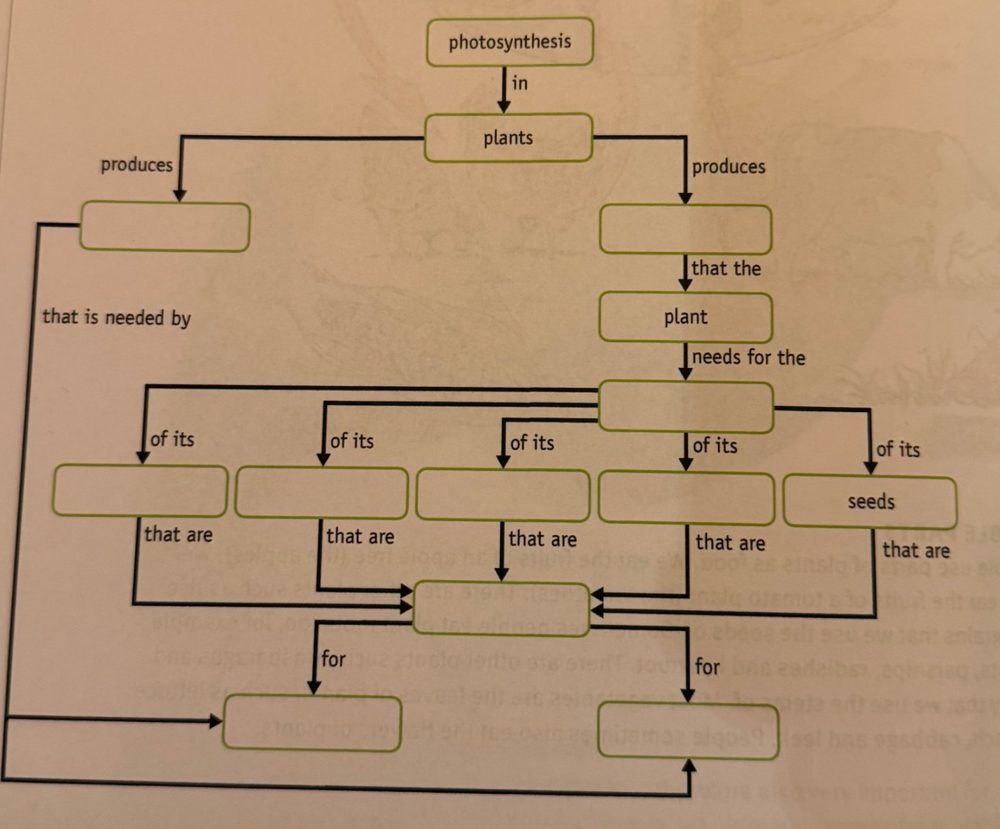
Plants make food for all other organisms on Earth. They do not eat other organisms themselves.
Substances and energy
Humans and animals need oxygen (from the air you breathe in), nutrients (substances your body needs to grow and develop; they come from food) and energy (also from food). Almost all food comes from plants or animals. Plants do not feed on other organisms: they make the substances they are made of themselves.
Glucose
Glucose is a kind of sugar that contains a lot of energy. The plant uses it to make all sorts of other high-energy substances, including the substances the plant itself is made of, so it can grow and make new parts (leaves, stems, fruits, seeds).
To make glucose the plant needs three things: water (from the ground, through the roots), carbon dioxide (a gas, from the air, through small openings in the leaves) and energy from light (for example the sun).
Photosynthesis
water + carbon dioxide + energy from light → glucose + oxygen
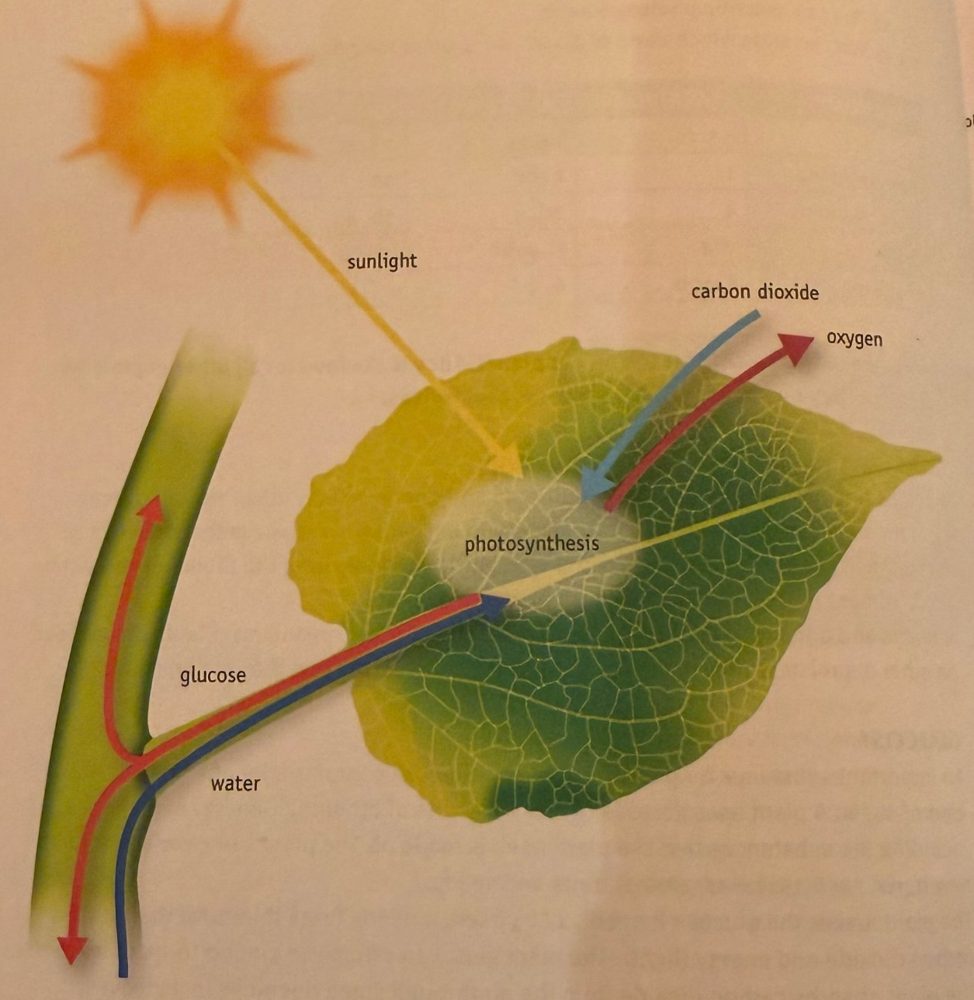
Photosynthesis = the process where a plant makes glucose using energy from light. It happens in all green parts of a plant, especially the leaves. It also releases oxygen through the same small openings in the leaves.
Why photosynthesis is important
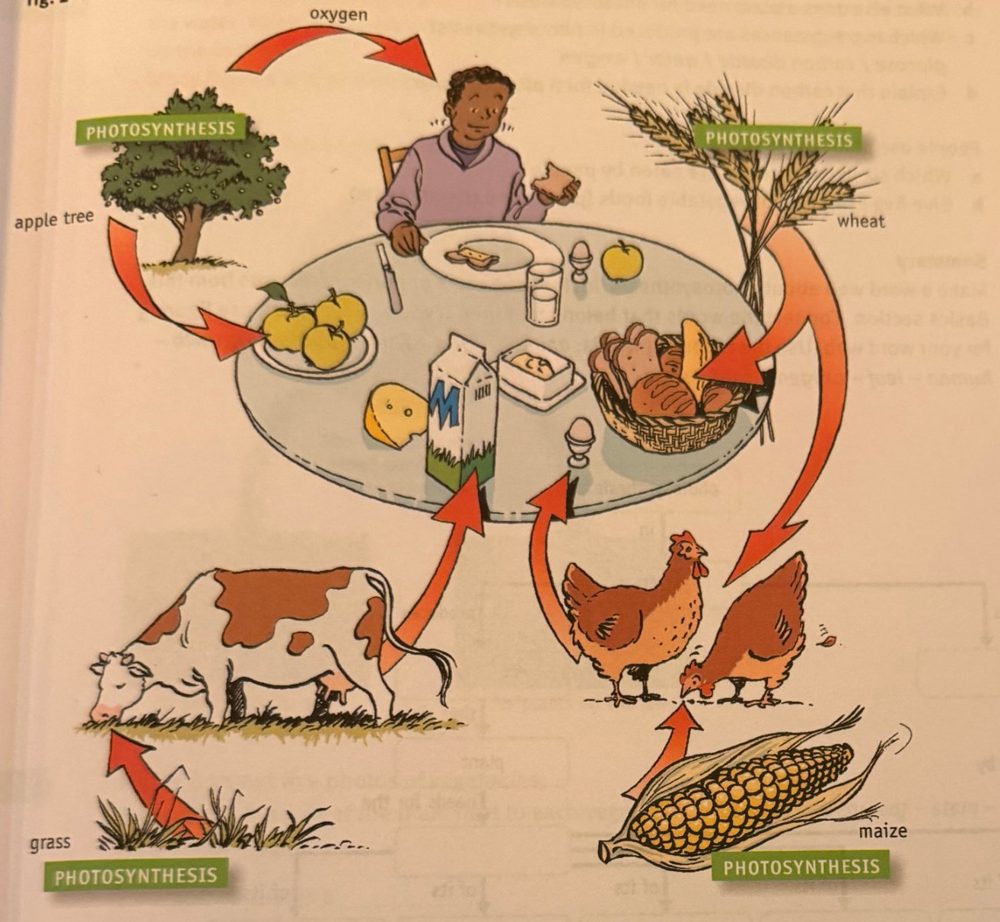
- Food: almost everything people eat ultimately comes from plants. Meat comes from a cow, but the cow ate grass. An egg comes from a chicken, but the chicken ate maize.
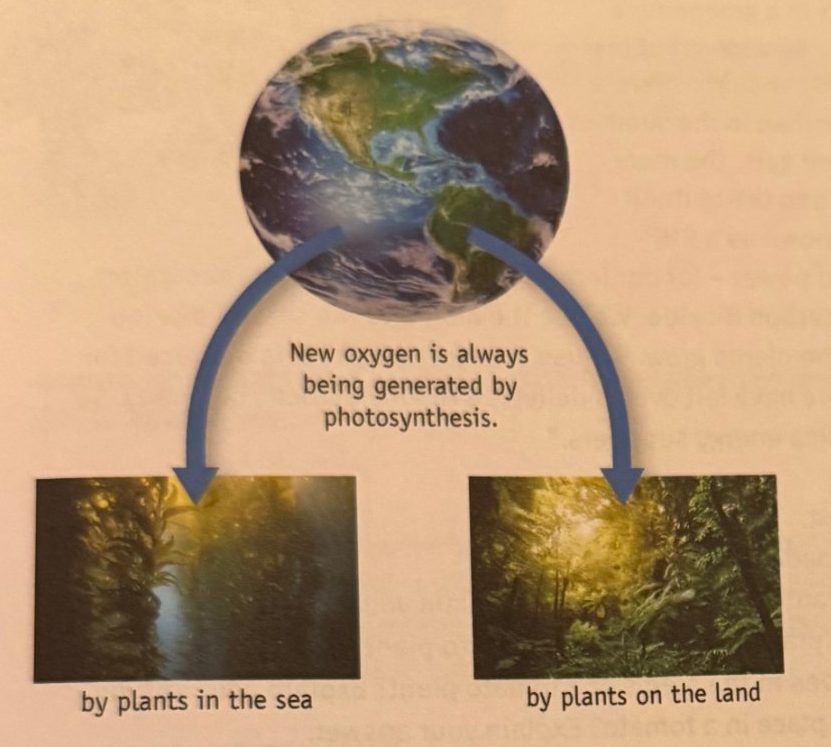
- Oxygen: photosynthesis keeps renewing the oxygen in the air. Without it, the oxygen would slowly all get used up.
Edible parts of plants
| Part | Examples |
|---|---|
| fruits | apples, tomatoes, bell pepper, cucumber |
| seeds | rice, grains (wheat, maize), peas, beans |
| roots | carrots, parsnips, radishes, beetroot |
| stems | asparagus, celery |
| leaves | lettuce, spinach, cabbage, leek (most vegetables) |
| flowers | cauliflower, broccoli |

Photosynthesis
What goes in, what comes out, where it happens and why it matters. 16 questions.
Word web
The summary exercise from the book (fig. 3): fill the ten boxes with the ten words. Tap a box, then tap a word.
Which part do we eat?
Fruit, seed, root, stem, leaf or flower? 20 vegetables.
Explain it
Cloudy days, lamps at night, water plants, solar energy, the tomato grower.
Flashcards
All the key terms from sections 1–3. Read the term, say the meaning, tap to check. Terms you didn't know come back at the end.
Exam mode
20 random questions from all sections, no hints. Goal: 18 or more. Do it until you hit the goal twice in a row.